

Welcome back to The Data-Driven Investor, an eight-part series on using better portfolio data to make more informed investment decisions.
In the first article, I wrote about why capital gains alone do not tell the full performance story.
In the second, I wrote about why having a strategy can help reduce emotional decision-making.
This third article is about how investors think markets actually work.
There are people who believe the earth is flat.
There are others who believe we’re living in a computer simulation.
Or that a hidden race of Lizard People are running society from the shadows.
There are a whole lot of different ways to make sense of the world we live in.
The same goes for the financial markets.
There are those who believe in the so-called ‘50% Principle’, that an uptrend may correct by around 50% before resuming its rise.
Others prefer ‘Odd Lot Theory’.
This is the idea that when smaller investors sell out of something, it may be a contrarian signal.
I know of one allegedly very wealthy investor who believes every financial market on the planet, property, stocks, commodities, you name it, moves in a repeating cycle, in which prices rise for a certain number of years, then fall for a certain number of years.
In today’s newsletter, though, I want to introduce and compare two of the less far-out, and more influential, theories about the market.
100% Efficient? 100% Of The Time?
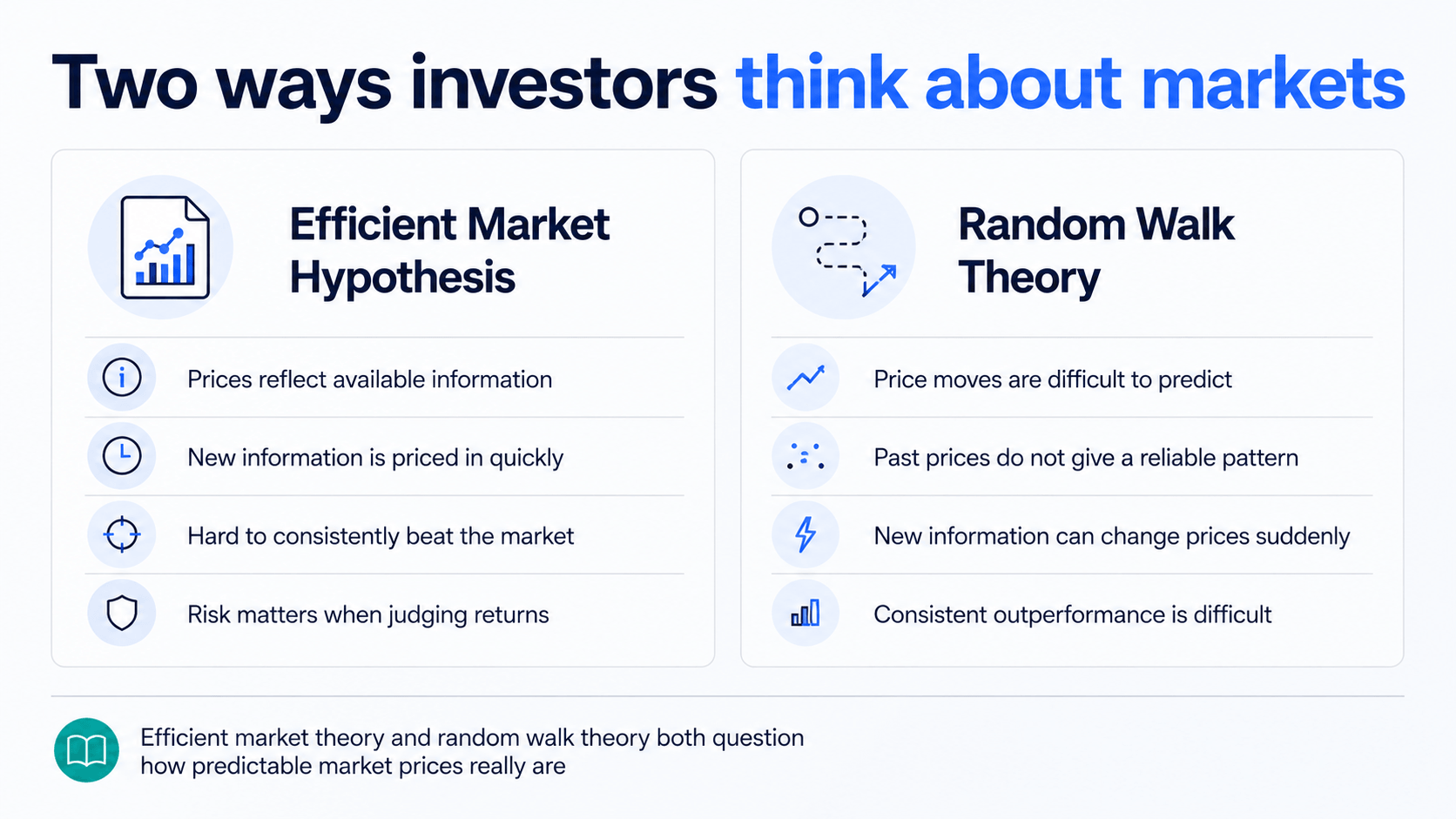
Efficient Market Hypothesis, or EMH, is the idea that the price of an investment reflects the information available to the market at a given time.
In other words, the market ‘prices in’ available information about an asset.
Because of this, EMH suggests it is very difficult to consistently ‘beat the market’ on a risk-adjusted basis.
The market is, in this theory, extremely hard to outsmart.
The ideas behind EMH go back a long way, but the theory is most often associated with American economist Eugene Fama, especially his work in the 1960s and 1970s.
It’s crucial to understand that in Fama’s EMH, the question is not simply whether someone can beat the market.
It’s whether they can consistently beat the market after accounting for risk.
In other words, higher returns may come from taking on higher risk.
Many investors, of course, aren’t keen to do this, which is possibly one reason there has been such an appetite for passive ETF investing in recent years.
EMH believers often favour keeping investment costs low and not spending too much time trying to outperform a market they believe is already hard to beat.
Opponents, on the other hand, believe markets are not perfectly efficient.
They believe prices can deviate from fair, or intrinsic, value.
Enter the next theory of how markets work.
The Market Is A Drunk Man
In 1827, Scottish botanist Robert Brown observed tiny particles from pollen grains moving in water under a microscope.
That seemingly random motion later became known as Brownian motion.
The idea of randomness was later applied to finance.
In 1863, French broker Jules Regnault wrote about the relationship between time and price variation in financial markets.
Then, in 1900, French mathematician Louis Bachelier developed an early mathematical model of speculation and random price movement.
These ideas helped form the background for what became known as Random Walk Theory.
This theory suggests that asset prices change in ways that are difficult to predict from past prices alone.
And, to make our lives even tougher as investors, if markets are reasonably efficient, new information may be reflected in prices very quickly.
Economist Burton Malkiel popularised this theory in 1973 with his book A Random Walk Down Wall Street.
He compared stock price movements to the steps of a drunk man.
Random. Unpredictable. Unreliable.
Random Walk Theory is another view of the market that leads many followers to believe it is extremely difficult to predict or consistently outperform the market.
At least, not without taking on extra risk.
What Do I Think?
I personally believe the market is not 100% efficient.
I believe it is quite efficient, but there is always room for investors to interpret information differently.
As a value investor, I believe there can be times when stocks trade above or below what I think they are worth.
But that does not mean this is easy.
And it definitely does not mean every investor can reliably identify mispriced investments.
A famous line often attributed to Benjamin Graham, and frequently repeated by Warren Buffett, says that in the short run the market is a voting machine, but in the long run it is a weighing machine.
That idea sits neatly with value investing.
Short-term prices can be driven by sentiment, popularity and emotion.
Longer-term results tend to depend more on business performance, cash flow, risk and valuation.
Or to put it another way:
Markets may not always reward investors for being smarter than everyone else.
They may reward investors for understanding risk, being patient, and having the discipline to follow a strategy.
More on that in a future edition.
Knowledge pays the best interest,
Navarre
The Data-Driven Investor
Track What Your Portfolio Is Actually Doing
However you think markets work, it helps to know what is happening inside your own portfolio.
Navexa helps investors track performance, income, currency impact, realised gains, unrealised gains and tax-related reporting data in one place.
That does not mean Navexa predicts the market.
It means Navexa can help you understand your own portfolio data more clearly, so you can review your investments with better information.
Start tracking your portfolio with more clarity.
Disclaimer
This article is general information only and does not constitute financial, legal or tax advice. It does not take into account your personal objectives, financial situation or needs. Investing involves risk. Market theories are simplified for educational purposes and should not be relied on as predictions or recommendations. Always speak with a qualified professional before making financial, legal or tax decisions.