

Welcome to The Data-Driven Investor, an eight-part series on using better portfolio data to make more informed investment decisions.
This first article is about one of the biggest mistakes investors can make: judging an investment by its share price alone.
One of the first stocks I ever bought was a total disaster. Or so I thought.
After holding it for five years, the value had risen 0%.
I would have been better off loaning the money to a friend and asking them to pay me $1 in interest.
So I logged into my broker account to sell my shares.
Before I hit ‘sell’, I figured I’d work out how much money the shares had generated in dividend income.
To my utter amazement, the dividends had nearly paid me back my whole investment.
This changed my perception of the investment completely.
What I thought had made me nothing had, in reality, generated close to 100% of my original investment back in income, before tax, fees and other costs.
It just hadn’t come through the capital gains I was looking for.
This is the power of knowing all the factors of investment performance.
Unfortunately, many investors don’t have an easy way to calculate things such as dividend performance.
This means they may end up making decisions based on incomplete data.
And as a data-driven investor, this pains me.
Here are the four things I think are worth understanding about any investment.
1. Capital Gains
Obvious, right?
Most investors buy into an investment hoping that the price will go up, resulting in a capital gain.
This is one of the main metrics to track for any investment.
Like I said, obvious. But important.
2. Dividend Income
As you saw in my story about the stock I nearly sold, dividends can have a huge impact.
If I hadn’t calculated the investment income and factored it into my performance, I could’ve sold this holding without understanding the full return picture.
Not only that, dividend income, in Australia at least, can carry tax implications.
These can be difficult to manage if you’re not properly tracking your investment income.
3. Currency Gain & Loss
This one is crucial when investing in foreign stocks.
Currency exchange rate fluctuations can have a major impact on investments.
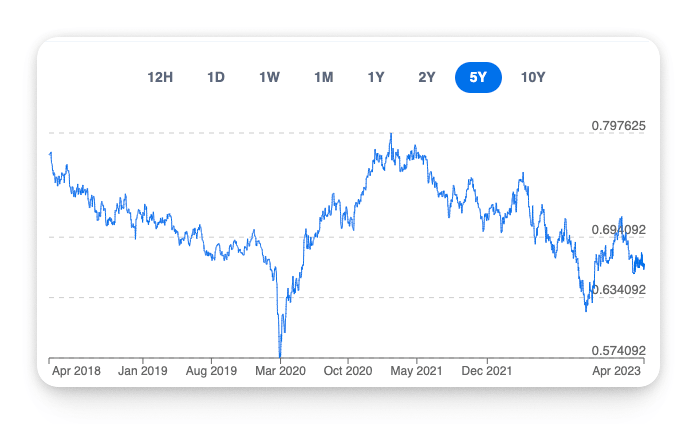
Say you bought a US$10,000 investment in a US stock from Australia in March 2020.
By December 2020, the exchange rate had turned around in dramatic fashion.
Assuming the share price of the stock hadn’t changed at all, the Australian-dollar value of that investment could still have fallen materially because of currency movement alone.
Depending on the exact buy and sell dates used, that movement could have reduced the Australian-dollar value by roughly a quarter.
Sometimes this shift is against you. Other times, it can work in your favour.
But if you don’t measure it, you’re not going to know either way.
4. Time
What do I mean by time?
Well let me ask you, would you rather make a 100% gain in one year...
Or a 100% gain over five years?
Most people I know would choose the first option. So would you, right?
Look at this scenario.
You buy Stock A for $1 and in the first year it goes up to $2.
Happy with the 100% gain, you keep holding this stock for another year.
But in that year, the price stays at $2.
So now, instead of thinking only about a 100% gain, you also need to consider the time it took to achieve that return.
You can see that if this plays out across a few more years, with the stock staying at $2, the annualised performance starts to look very different.
Which is why it is important to factor in time when you analyse your investment performance.
This is what we mean when we talk about annualisation.
These Are The Four Pillars Of Investment Performance
Capital gains. Income. Currency gains and losses. Time.
These are what I call the four pillars of investment performance.
Any investor who wants to understand their portfolio more clearly may benefit from tracking these factors.
Remember how I nearly sold a stock that had, in pre-tax total-return terms, roughly doubled my money?
That is the sort of decision an investor might make if they don’t have all the information.
It’s very rare for anyone to fluke their way to success or wealth.
For many people, having a plan, a strategy and a certain amount of discipline is a better path than trying to get rich quickly with a financial fluke.
This is why I’m a data-driven investor.
Because if you can’t measure it, you can’t improve it.
The data doesn’t lie,
Navarre
The Data-Driven Investor
Track More Than Just The Share Price
Navexa helps investors track portfolio performance, income, currency impact, realised gains, unrealised gains and tax-related reporting data in one place.
It is designed to help you see the bigger picture behind your portfolio, so you can have better information before speaking with your accountant, tax adviser or financial adviser.
Start tracking your portfolio with more clarity.
Disclaimer
This article is general information only and does not constitute financial, legal or tax advice. It does not take into account your personal objectives, financial situation or needs. Past performance is not a reliable indicator of future performance. Investment returns, dividend income, currency movements, fees and tax outcomes can vary. Always speak with a qualified professional before making financial, legal or tax decisions.